Explore year-end tax tips, QCD advantages, legacy planning insights, and the Morton Community Foundation’s December Fundaversaries

Hello from the MCF!
Thank you for the opportunity to work together! It is our honor to celebrate and recognize the conclusion of another year full of stories and examples of people like you who make a difference every day in our community through your advocacy, volunteerism, and financial support of our community’s charities.
As we reflect on 2025, we’re sharing three insights that have resonated with many charitable individuals and families, many of whom have established a fund at the Morton Community Foundation or are in the process of doing so right now!
It’s not over until it’s over, and we’re taking this opportunity to share practical year-end reminders, especially considering that, for taxpayers who itemize deductions, 2025 may be the best tax environment to maximize your charitable giving by donating appreciated stock to a donor-advised fund. And of course, if you are over the age of 70½, don’t forget to consider QCDs from IRAs as you check your beneficiary designations. The MCF is here to help! READ MORE
Unrestricted gifts are a powerful way for you and other donors to invest in long-term support for ever-evolving community needs. As a permanent, flexible, and trusted institution, the Morton Community Foundation is here to help you evaluate how unrestricted gifts might be the perfect complement to your portfolio of giving, alongside your donor-advised fund and legacy gift, for example. QCDs are a particularly important way to support an unrestricted fund if you are 70½ or older. READ MORE
People who don’t have children often embrace intentional planning about their legacies and are statistically more likely to include charities in their estate plans. If you’re one of these people, reach out to the MCF. We’ll help you set up charitable giving strategies to express your identity, integrate philanthropy into your estate and financial plans, and involve your extended family or younger relatives along your journey. READ MORE
Each month, we also like to highlight the various funds that were created in that same month throughout our history. Don’t miss our December Fundaversaries feature below — celebrating the generosity of fund founders whose vision continues to make a difference today. LEARN MORE
Whatever causes you support and wherever your charitable interests lie, the Morton Community Foundation is here for you. We are honored to serve as your home for charitable giving to help you organize your support for favorite charities and make a meaningful difference in the lives of people who live in this wonderful place we call home. We wish you all the best for the season!
Scott Witzig, Executive Director
Darcy Roecker, Administrative Manager
info@cfmorton.org • 309-291-0434

Countdown to 2026: 10 Tips for Charitable Giving
At the Morton Community Foundation, we are honored to work with you and so many other families, individuals, and businesses to help organize your charitable giving and support favorite charities that make a difference in our community. As the year winds down, keep these 10 tips in mind:
Remember that 2025 is a pivotal year for charitable planning. With more stringent charitable deduction limitations taking effect in 2026 under new tax laws, this year may offer a favorable tax environment for your giving depending on your personal situation. Talk with your tax advisors as soon as possible.
Work with your tax advisors to evaluate the benefits of “bunching” multiple years of charitable gifts into 2025. By front-loading contributions — especially into your donor-advised fund at the MCF — you may be able to exceed the standard deduction this year and maximize your tax benefits.
Use your donor-advised fund to simplify year-end giving. You can make one tax-deductible contribution now, receive the deduction in 2025, and recommend grants to nonprofits over time, even throughout 2026 and beyond.
Give appreciated stock instead of cash. Donating long-term appreciated securities to your fund at the Morton Community Foundation may eliminate capital gains tax and in turn increase your charitable impact. Talk with your tax advisors as soon as possible so that these gifts can be processed well before the end of the year. LEARN MORE on our Donate Stock page.
Explore giving from your IRA if you’re 70½ or older. A Qualified Charitable Distribution (QCD) can reduce taxable income and, if applicable, satisfy required minimum distributions — to the tune of $108,000 per taxpayer in 2025. IRS rules allow you to make QCDs to a wide variety of funds at the MCF (but not to your donor-advised fund). LEARN MORE about QCDs on our website.
Check to see whether you’ve met your charitable goals for 2025. Don’t wait until late December to review your plan. We can help you think through options for this year and begin to coordinate more complex gifts for next year.
Support the community overall by making gifts to the Morton Community Foundation’s Morton Impact Fund or Today and Tomorrow Fund (day-to-day operations fund). 2025 has been a tough year for many people in our community, and our team can help you support families in crisis both now and in the future.
Review your beneficiary designations. Naming your donor-advised fund or another MCF fund as a beneficiary of an IRA or other retirement account can create meaningful future gifts while reducing the tax burden on heirs.
Avoid last-minute surprises. Gifts of complex assets — such as real estate or closely-held stock — require additional steps and a lot of lead time, so contact the Morton Community Foundation early if you’re considering these options. Even if it is too late to complete these gifts in 2025, start working with the MCF on options for 2026 gifts.
Above all, lean on the MCF! We are here to help you explore the most tax-efficient ways to meet your charitable goals, whether you’re planning year-end gifts, updating a legacy plan, or thinking ahead to the changes coming in 2026.
It is our honor to work with you! Thank you for the opportunity. We look forward to supporting your charitable goals this year and for many years to come.
Contact us at: email: info@cfmorton.org • phone: 309-291-0434
Unrestricted Giving, QCDs, and Why They Matter for Your Philanthropy

As someone who cares deeply about Morton, you already understand how important charitable giving is to improving the quality of life. Every year, Americans give nearly 2% of our nation’s GDP to charitable causes — an impressive level of generosity that supports more than a million nonprofits across the country. At the same time, trust has become one of the most important factors donors consider when deciding where to give. We are honored that so many of you place your confidence in the Morton Community Foundation to steward your philanthropy with care and integrity.
The MCF is your home for charitable giving, no matter what causes you support. Simultaneously, we are committed to understanding the needs of our community and sharing that information with you and other donors to help ensure that charitable dollars are invested where they can do the greatest good. Some needs are urgent, while some are long-term. Because Morton’s needs evolve over time, the Morton Community Foundation is focused on identifying what matters most at any given moment and helping you ensure that your generosity has a meaningful impact both immediately and across generations.
For donors aged 70½ and older, one of the most effective and tax-savvy charitable giving tools available is the Qualified Charitable Distribution, or QCD. A QCD allows you to direct up to $108,000 in 2025 from your IRA to a qualified public charity — bypassing taxable income. If you are already taking required minimum distributions (RMDs), a QCD will count toward that amount without increasing your adjusted gross income, which can be especially helpful for managing tax brackets, Medicare IRMAA surcharges, and other income-related considerations.
QCDs cannot be directed to donor-advised funds. So, many donors choose to use their donor-advised fund to support their favorite charities through regular annual gifts, and then use their QCDs to support an unrestricted fund at the MCF. An unrestricted fund enables the Morton Community Foundation’s board and staff to deploy dollars toward the most pressing and emerging needs right here at home. It is one of the most powerful ways to support your community, both now and in the future.
Be sure to talk with your tax advisors about whether a QCD fits into your 2025 charitable giving plans. Looking ahead, with new tax laws taking effect in 2026, QCDs may become even more valuable, so be sure to discuss next year’s opportunities, too.
No matter which tools you use — your donor-advised fund, a QCD to an unrestricted fund, or other giving strategies — the MCF is here to support you. Please reach out anytime. We are honored to partner with you to ensure your generosity continues to make a meaningful difference in the community we all love.
Contact us at: email: info@cfmorton.org • phone: 309-291-0434

No Kids? Three Calls-to-Action for Charitable Planning
Many people without children wonder how their legacy will take shape. Rather than focusing on biological heirs, they often find freedom to channel their resources, time, and values toward the broader community. Indeed, Americans over age 50 without children are more than four times as likely as parents to have a charitable estate plan. If you fall into this group — or advise family members who do — take a moment to consider adopting an intentional philanthropic strategy.
The Morton Community Foundation is happy to help. Reach out anytime for a conversation! Here are three themes we’ll consider as we begin our dialogue:
Treat charitable giving as an expression of identity.
For people without children, the causes they champion often become extensions of their values and impact. A fund at the MCF can bear the name of its donors or something else entirely to represent the priorities of its founders. Examples of fund names include “Kuhl Family Charitable Fund,” “Lanie Riddle Memorial Fund for St Jude Children’s Hospital,” “Something for Others Fund,” “Critter Meals on Wheels Fund,” or anything else meaningful to the donors who create it. The choice is yours! To review all of our endowment funds and their names & stories, CLICK HERE.
Integrate charitable planning into estate planning.
People who do not have children often have greater flexibility in determining how their wealth will create lasting meaning and impact beyond their lifetimes. By integrating charitable planning into their estate and financial strategies, they can direct resources toward causes that reflect their values and ensure their legacy benefits the broader community. Without the need to provide for heirs, charitable planning offers a thoughtful way to give purpose to accumulated assets and make a difference for future generations. We will discuss ways to involve your estate planning advisors in structuring charitable plans with the Morton Community Foundation’s help.
Branch out to extended family.
Without the generational handoff of children, people without children might have flexibility most donors don’t. This can mean involving nieces, nephews, other younger relatives, or community members in the philanthropic journey, building a multi-year giving plan, or shifting giving based on changing community needs. Remember, when you establish a donor-advised fund at the MCF, you can name successor advisors to take your place in recommending charities to receive distributions.
Whether or not you have children, the Morton Community Foundation is a sounding board and resource every step of the way. Please reach out to learn more about how we can help you and your family build a charitable plan that is tailored to both your personal and family goals, as well as your goals for making a difference in the causes you care about. The MCF has a document called, “Honored to Serve as the Hub of Your Philanthropy,” which you can download HERE
Contact us at: email: info@cfmorton.org • phone: 309-291-0434
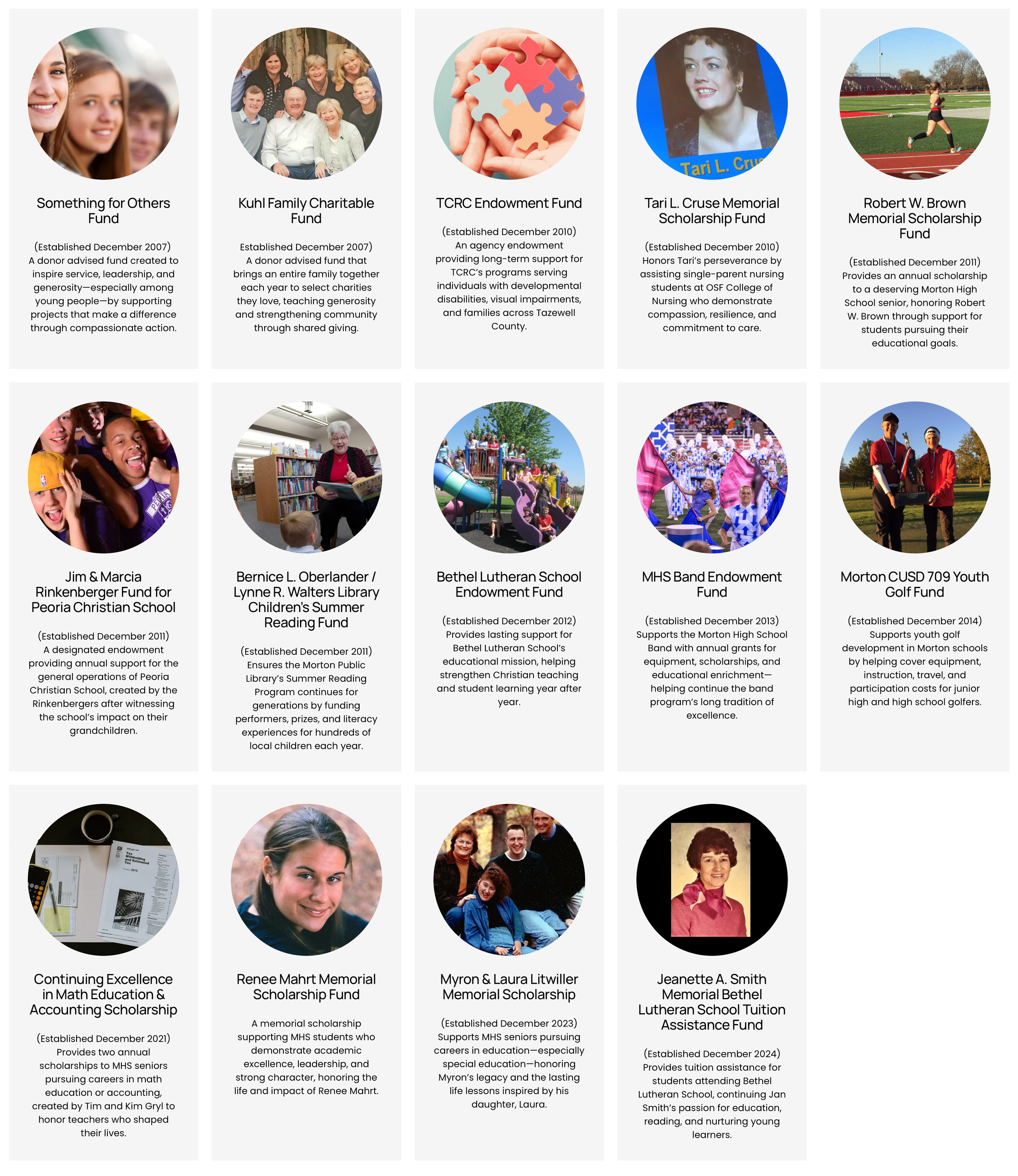
December Fundaversaries
The stories of endowment funds established over the years in the month of December.
Each month, we pause to honor the donors whose generosity continues to shape Morton through the power of permanent endowment. These funds—created by families, alumni, community volunteers, and friends—are still making an impact years and even decades after they were established.
From scholarships and youth programs to Christian education, library initiatives, community service, and support for individuals with disabilities, these December Fundaversaries remind us that lasting change begins with a single decision to give.
To scan through this month’s Fundaversaries, click below to learn more about each story of generosity and the lives they continue to touch.
Thank you to the donors who planted these seeds of hope—your legacies are still growing strong.
The team at the Morton Community Foundation is honored to serve as a resource and sounding board as you build your charitable plans and pursue your philanthropic objectives for making a difference in the community. This newsletter is provided for informational purposes only. It is not intended as legal, accounting, or financial planning advice. Please consult your tax or legal advisor to learn how this information might apply to your own situation.